
Short answer: Pool resurfacing replaces the worn interior finish of a concrete pool. Most of the pools we resurface in Tucson have been in the ground fifteen to twenty years, and hard water and sun have worn the surface rough, stained or chalky. We drain the pool, chip out the old finish, repair what we find, apply a bond coat and a new plaster, quartz or pebble interior, and then the pool goes through a 28 day startup period.
Last checked: November 2026. Code points are linked to the jurisdiction that wrote them. Everything else describes how Omni Pool Builders and Design does the work.
Pool resurfacing facts
| Question | Answer | Source |
|---|---|---|
| What resurfacing is | Removing a worn pool interior and applying a new finish over the concrete shell | Omni remodel and resurfacing page |
| Typical age of the pools we resurface | Fifteen to twenty years in the ground | Omni remodel and resurfacing page |
| Finish options | White plaster, colored and quartz plaster, exposed aggregate such as PebbleTec, glass bead and polished finishes | PebbleTec compared with other finishes |
| Longest lasting finish in our climate | Exposed aggregate | Omni remodel and resurfacing page |
| After the new finish goes in | A 28 day startup period | Tucson pool cost and timeline guide |
| Evaporation cover on a remodeled pool | Required before final inspection in Oro Valley and in unincorporated Pima County | Oro Valley ISPSC amendments 303.4; pool cover rules in Southern Arizona |
| Check the contractor | Look up the license and its classification before you sign | Arizona ROC contractor search |
| Omni’s license | ROC 282151, KA-5 dual swimming pool, residential and commercial | ROC record for 282151 |
Signs your pool needs resurfacing
- Rough plaster that scrapes feet and snags swimsuits.
- Stains that will not brush out.
- Chalky or dark patches where the surface has worn through.
- Hairline crazing that keeps collecting dirt no matter how often the pool is cleaned.
- Waterline tile coming loose or grout letting go. That is a tile problem, but it is usually fixed in the same trip.
One of these on its own can sometimes wait. Two or three together usually mean the finish is done.
How we resurface a pool
- Site visit and written scope. We walk the pool and the equipment pad and look at the interior, tile, coping, deck, the shell for movement, the equipment and the bond. You get a written scope that separates what is required, what we recommend and what is optional. We do not quote a resurface off a photo.
- Drain and chip out. The pool is drained and the old interior is chipped back to sound material.
- Repairs before finish. Movement cracks in the shell and failed plumbing behind the light niche get fixed before anything decorative goes back in.
- Check what only shows when the pool is empty. Main drain covers, returns, skimmer throats, light niches and the bond wire are all looked at while they are exposed.
- Bond coat and new interior. A bond coat goes on and the new finish is applied.
- Startup. The pool is filled and goes through a 28 day startup period while the new surface cures in the water.
Waterline tile and coping are often done at the same time, because the pool is already drained and the waterline is already exposed. Doing them later means draining the pool twice and paying for two mobilizations.
Finish options
| Finish | What to know |
|---|---|
| White plaster | The least expensive finish and the shortest lived. |
| Colored and quartz plaster | Hold up better than white plaster and change the color of the water. |
| Exposed aggregate, including PebbleTec | The longest lasting finish in our climate. Most of our remodel clients choose it once they compare service life. |
| Glass bead and polished finishes | Available where the look justifies the cost. |
Going from plaster to a pebble finish, or adding a water feature at the same time, can change the hydraulics. Equipment that was right for the old pool may not be right for the new one, so we check the sizing as part of the scope. More on finishes: PebbleTec compared with other finishes.
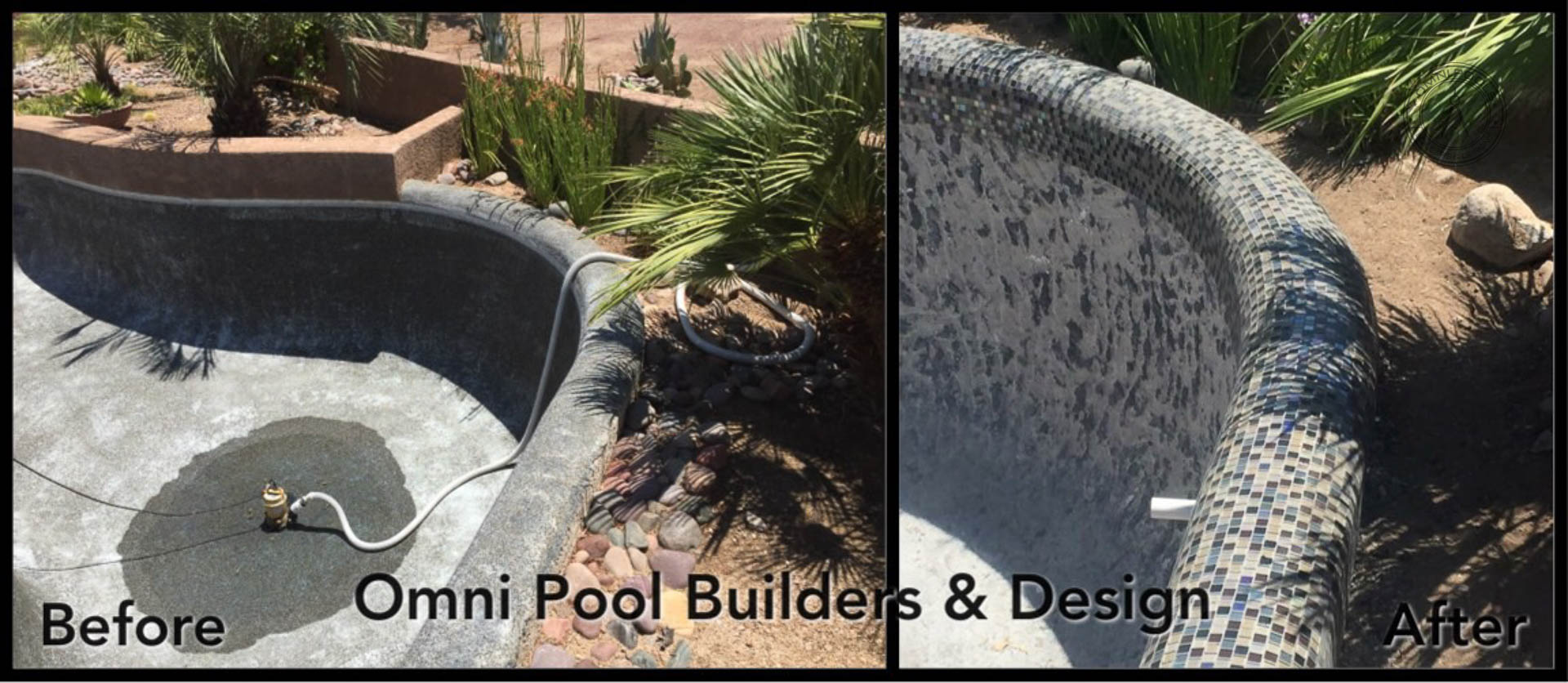
Before and after

Permits and the cover rule
Permit rules are not the same in every jurisdiction around Tucson, and a remodel that touches the barrier or the deck can bring barrier and setback rules into play. When a permit is required, we pull it.
Oro Valley and unincorporated Pima County both require a cover that limits evaporation on remodeled outdoor pools and spas before final inspection approval. Ask every bidder how they are handling it. A bidder who does not know the rule may leave you at a failed final inspection. See pool cover rules in Southern Arizona, Oro Valley pool permits and Pima County pool permits.
How to choose who resurfaces your pool
- Look the contractor up on the Arizona ROC contractor search and confirm the license is active and the classification covers a full interior replacement.
- Get the scope in writing, line by line, with the finish named by brand and color.
- Ask what gets inspected and repaired while the pool is empty, and how repairs found after chip-out are priced.
- Ask how the evaporation cover rule is handled if you are in Oro Valley or unincorporated Pima County.
- Get the warranty in writing.
Omni Pool Builders and Design has built and renovated pools in Tucson since 2012. We hold Arizona ROC licenses 282151 (KA-5 dual swimming pool) and 326882 (CR-21 hardscaping), are BBB A+ accredited since 2013, are a Pool and Hot Tub Alliance member, and won Arizona Daily Star Readers’ Choice awards from 2019 to 2026.
Frequently asked questions
How do I know if my pool needs resurfacing?
Rough plaster, stains that will not brush out, chalky or worn-through patches and hairline crazing are the usual signs. Most of the pools we resurface in Tucson have been in the ground fifteen to twenty years. A site visit tells you whether the finish is done or can wait.
What is the difference between resurfacing and replastering?
Replastering is one kind of resurfacing. It puts a new plaster coat, white, colored or quartz, on the pool. Resurfacing also covers exposed aggregate finishes such as PebbleTec and glass bead finishes. See pool replastering in Tucson.
Which pool finish lasts longest in Tucson?
Exposed aggregate finishes, including PebbleTec, last the longest in our climate. White plaster is the least expensive and the shortest lived. Colored and quartz plasters sit in between.
What happens after the new finish goes in?
The pool is filled and goes through a 28 day startup period while the new surface cures in the water. You get startup instructions with the job.
Do I need a pool cover after resurfacing?
In Oro Valley and unincorporated Pima County, yes. Both require a cover that limits evaporation on remodeled outdoor pools and spas before final inspection approval. Other jurisdictions set their own rules.
Should I replace the tile and coping at the same time?
Usually. The pool is already drained and the waterline is already exposed, so doing tile and coping in the same trip avoids draining the pool twice and paying for a second mobilization.
How much does pool resurfacing cost?
We price resurfacing from a site visit, not a photo. The finish you choose, the size of the pool, repairs found after chip-out, and whether tile, coping or equipment are included move the number. You get a written scope with each item as its own line.
Related reading
- Pool remodeling and renovation in Tucson
- Pool replastering in Tucson
- What a pool costs in Tucson and how to choose a builder
- Pool cover rules in Southern Arizona
- Pool removal, if you are weighing a remodel against taking the pool out
Call (520) 222-8503 or request a site visit. Omni Pool Builders and Design, 6640 N Oracle Rd, Suite 130, Tucson, AZ 85704.